Market Environment
Japan’s BESS market is expected to reach up to 337GWh over the next 15 years
As renewable energy adoption continues to expand, demand for grid balancing capacity—essential for maintaining power system stability—is increasing. Even if output from nuclear and gas-fired power generation rises in the future, balancing capacity will remain necessary to absorb excess electricity through charging during periods of oversupply and to provide instantaneous discharge when needed. Based on our internal estimates, Japan will require up to 337 GWh of battery storage capacity by 2040.※1
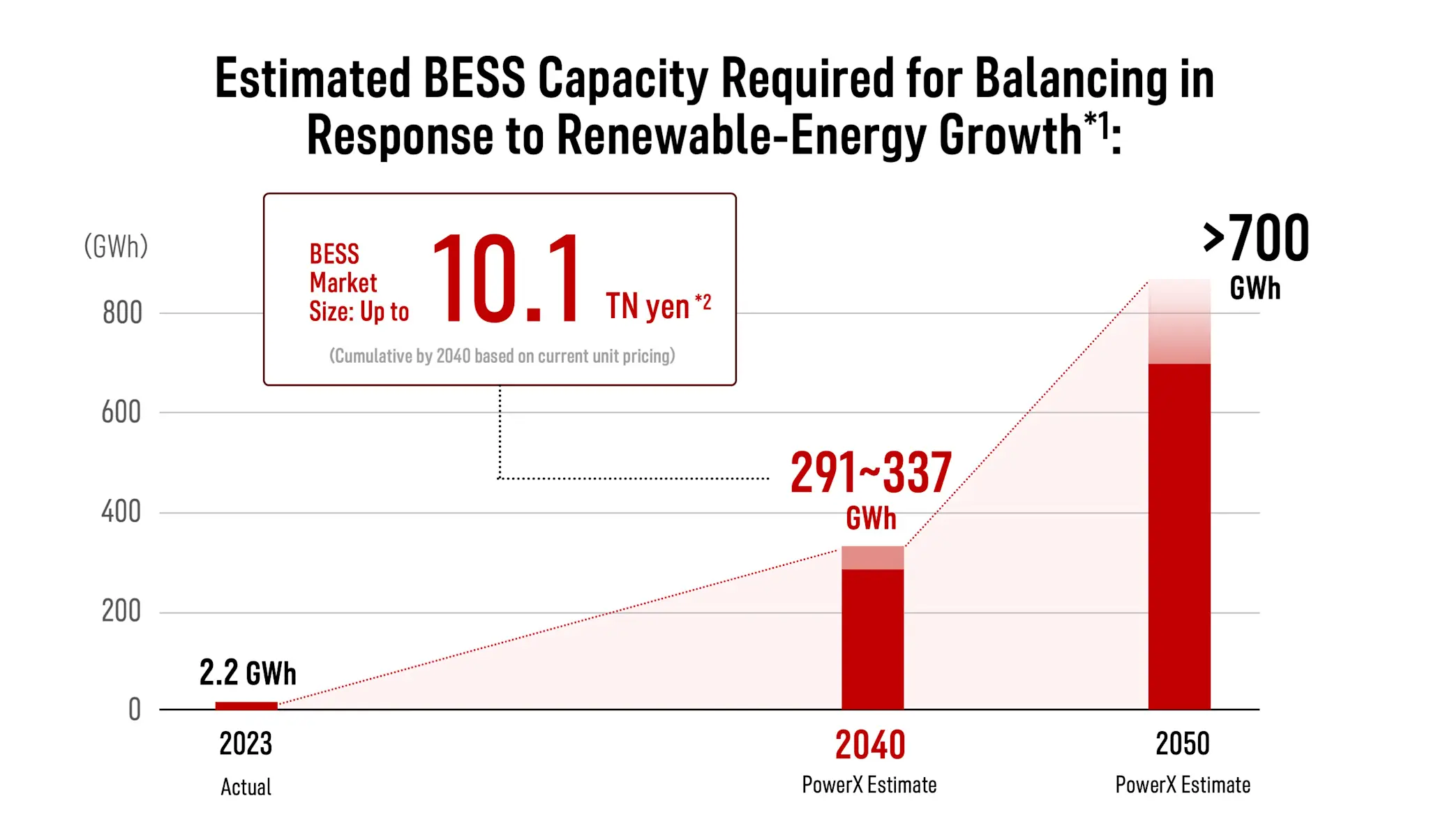
※1 All figures referenced in the main text are estimates based on publicly available information, including data published by the Ministry of Economy, Trade and Industry (METI) and the Agency for Natural Resources and Energy. The 2040 estimates are derived from the Japanese government’s projected energy mix under the 7th Strategic Energy Plan and its forecast of total electricity generation in 2040. The 2050 estimates are based on government projections and the target non-fossil power generation ratios outlined in the “Wide-Area Grid Master Plan” (Organization for Cross-regional Coordination of Transmission Operators, Japan; 2022 report), with additional assumptions applied for other renewable generation volumes. In particular, 2050 figures are expressed on an energy (electricity) basis and do not include capacity or battery storage volumes. Assumptions regarding nuclear and thermal power capacity in 2050 account for potential additions beyond government-presented capacity and capital investment plans. Estimates for ammonia co-firing, coal-fired capacity, and generation volumes are based on maximum feasible generation derived from existing government classification frameworks. All other figures represent the battery storage capacity estimated by the Company to be required for BESS deployment and may vary depending on future conditions and assumptions.
※2 Calculated assuming no price fluctuations through 2040 and a battery system unit price of ¥30,000 per kWh.
The Role of BESS in Strengthening Japan’s Energy Security
By 2040, the battery storage capacity required in Japan is expected to exceed the total power output of all domestic nuclear power plants. From an energy security perspective, strengthening the security of BESS infrastructure is therefore becoming increasingly important.
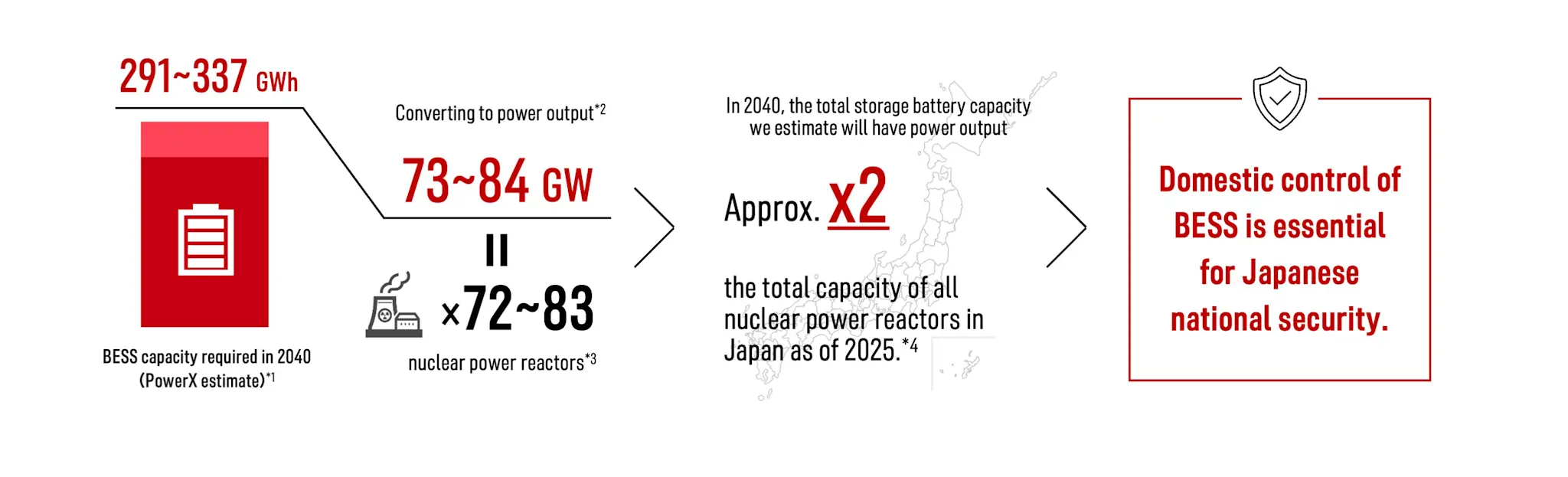
※1 All figures cited in the main text are estimates based on publicly available information, including data published by the Ministry of Economy, Trade and Industry (METI) and the Agency for Natural Resources and Energy. The 2040 estimates are derived from the Japanese government’s projected energy mix under the 7th Strategic Energy Plan and its forecast of total electricity generation in 2040. Other renewable energy generation figures are based on the Company’s own assumptions. The upper limit shown in the bar chart represents the estimated battery storage capacity required if all aging pumped-storage hydropower facilities were to be fully replaced by BESS providing grid-balancing functions upon reaching the end of their service life; actual replacement may differ due to various factors.
※2 Calculated by dividing the GWh figures by four hours, which reflects the typical discharge duration of lithium-ion batteries in Japan.
※3 Calculated based on the average output of nuclear power plants currently installed in Japan (1,003 MW as of 2025). (Source: Nuclear Regulation Authority of Japan)
※4 Calculated based on the total approved generation capacity of existing domestic nuclear power plants (33.08 GW as of 2025). (Source: Nuclear Regulation Authority of Japan)
Source: Renewable Energy Institute, 2023 (https://www.renewable-ei.org/pdfdownload/activities/REI_BatteryStorage_JP.pdf)

